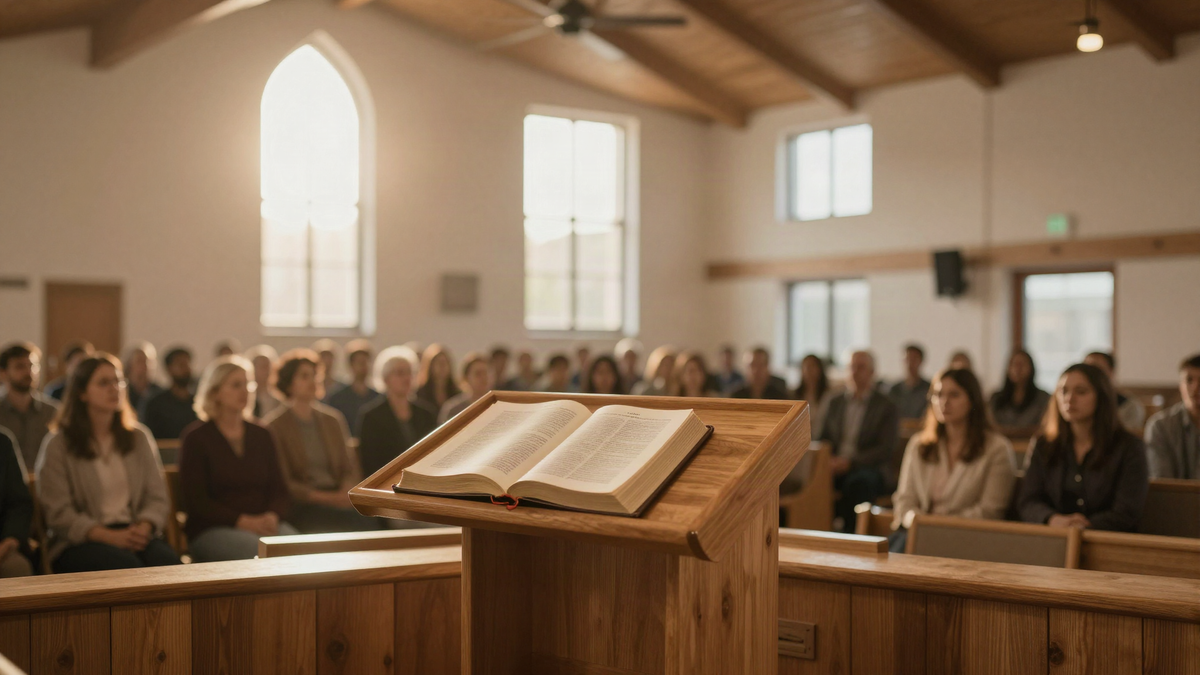
How to Study the Bible: A Step-by-Step Guide for Beginners
Summary: To study the Bible, choose one book, read a short passage slowly and work through four steps: pray before you start, observe what the text actually says, interpret what it meant to its first readers, and apply it to your life this week. Write down what you notice and turn it into prayer. A Gospel such as John or Mark is the best place for most beginners to start.
Scripture quotations in this guide are from the King James Version (KJV).
Lots of people own a Bible. Far fewer feel confident opening it. Perhaps you have started at Genesis with the best intentions and stalled somewhere in Leviticus. Or maybe you read a few verses each morning, but they slide out of your mind by lunchtime. You are not alone, and you are not unspiritual. Most of us were simply never shown how.
The good news is that Bible study is a skill, and skills can be learned. You do not need a theology degree or a shelf of commentaries. You need a Bible, a notebook, a little time and a willingness to slow down. This guide will show you where to start, give you a simple method you can use with any passage, point you to a few helpful tools and help you lead a small group if you are ready for that.
What is the difference between reading and studying the Bible?
Both matter, and they work together. Reading is about breadth. When you read through a whole book or follow a yearly plan, you take in the big story, the sweep of God's dealings with His people from creation to the new creation. It is like flying over a landscape and seeing the shape of the land.
Studying is about depth. It means stopping at a single passage, sometimes a single verse, and asking careful questions until it opens up. It is more like walking that landscape on foot, noticing the wildflowers and the turns in the path.
A healthy diet includes both. Many people read a chapter or two each day and then pick one shorter section each week to study in depth. Over time, the big picture helps you understand the details, and the details make the big picture come alive.
Where should a beginner start?
The Bible is not one book but a library of sixty-six, written over many centuries in different styles: history, poetry, law, prophecy, letters and more. Starting at page one and reading straight through is a noble idea, but it is not the easiest route for a newcomer.
Instead, start with Jesus. The Gospel of John was written, in its own words, "that ye might believe that Jesus is the Christ, the Son of God; and that believing ye might have life through his name" (John 20:31). It is clear and full of conversations with real people. If you prefer something shorter and fast-paced, the Gospel of Mark can be read in a couple of hours.
After a Gospel, many people find these books especially helpful early on:
- Psalms for prayer and honesty with God in every kind of season.
- Philippians, a short, joyful letter about contentment and following Christ.
- Acts, which tells the story of how the early church began.
- Genesis, which lays the foundation for the whole biblical story.
Once you have spent time in those, you will be far better equipped to read the rest of the Bible with understanding.
A simple 4-step method for studying any passage
This method works for a single verse or a whole chapter, on your own or in a group. Give it twenty to thirty minutes the first few times. It will get quicker with practice.
Step 1: Pray first
Before you open the text, ask God to help you understand it. "Open thou mine eyes, that I may behold wondrous things out of thy law" (Psalm 119:18). This is not a box to tick. The Bible is not merely an ancient document to analyse. Christians believe the same Spirit who inspired it is present to help us understand and live it. Coming humbly makes a difference.
Step 2: Observe: what does it say?
This step is about slowing down and noticing. Read the passage at least twice, ideally once out loud. Then write down what you see. Who is speaking, and to whom? Where are they and what is happening? Look for repeated words, commands, promises, contrasts and connecting words such as "therefore" or "but." A good rule of thumb is that when you see "therefore," ask what it is there for.
Resist the urge to jump to meaning or application yet. Most mistakes in Bible study come from skipping this step and reading our own assumptions into the text.
Step 3: Interpret: what did it mean then?
Now ask what the passage meant to the people who first heard it. The Bible was written for us, but it was not written to us first. Paul's letter to the Philippians was mail to a real church in a real Roman city.
Helpful questions at this stage include:
- What kind of writing is this: a story, a poem, a law, a letter or a prophecy?
- What comes immediately before and after this passage?
- How does this fit the purpose of the whole book?
- Do other parts of the Bible shed light on it? Cross-references in the margin of many Bibles help here.
Context protects us from twisting Scripture. Philippians 4:13, "I can do all things through Christ which strengtheneth me," is often quoted as a promise of success. Read in context, Paul is talking about being content whether he has plenty or very little. That is a deeper and more durable promise. We unpack that verse in our guide to Bible verses for every season.
Step 4: Apply: how will I live it?
Bible study is not finished when we understand a passage. It is finished when we start to live it. James puts it sharply: "But be ye doers of the word, and not hearers only, deceiving your own selves" (James 1:22).
Good application is specific. "I should be more loving" is vague. "I will call my sister this week and apologise for what I said at Christmas" is something you can actually do. Ask yourself whether the passage shows you a promise to trust, a command to obey, a sin to confess, an example to follow or a truth about God to worship Him for. Then pick one and write down your next step.
Finish by turning what you learned into prayer. If the passage spoke about God's faithfulness, thank Him for it. If it challenged you, ask for help to change.
What tools make Bible study easier?
You can study the Bible with nothing more than the text itself and a pen. Still, some simple tools can deepen your understanding.
- A study Bible. These include introductions to each book and notes that explain historical background. They are a great first purchase.
- A second translation. Comparing a traditional translation like the King James Version with a modern one can bring out shades of meaning you would otherwise miss.
- A concordance or Bible app search. This lets you look up every place a word appears, which is fascinating for tracing themes such as "grace" or "covenant."
- A journal. Writing slows your thinking and helps you remember. Over months, your notes become a record of what God has taught you.
- A Bible dictionary. When you hit an unfamiliar place or custom, a dictionary fills in the gaps quickly.
Be careful not to let tools replace the text. Read the passage and do your own observing first. Then turn to notes and commentaries to check and enrich what you found.
How do I lead a small-group Bible study?
Studying Scripture with others is one of the richest experiences in the Christian life. Someone will always notice something you missed. And when life gets hard, the people you have opened the Bible with become the people who carry you.
If you have been asked to lead, or you would like to start a group, here are some practical pointers:
- Prepare, but do not lecture. Study the passage yourself during the week so you understand it, then plan to guide a conversation rather than give a talk.
- Read the passage aloud together. Ask different people to read so everyone is engaged.
- Ask open questions. Avoid questions that can be answered with "yes" or a single word. Questions that begin with "what" or "how" usually work best.
- Let silence work. When you ask a question, wait. Count to ten in your head if you need to. People often need a moment to think.
- Close with prayer and a next step. Ask each person what one thing they will take away, and pray for one another.
Here are some discussion questions that work with almost any passage:
- What stands out to you most in this passage, and why?
- What does this passage teach us about God?
- What does it teach us about ourselves?
- Is there anything here that you find confusing or hard to accept?
- What is one way you could put this into practice this week?
How much time should I spend studying the Bible?
Consistency beats intensity. Fifteen minutes a day, most days of the week, will shape you far more than a marathon session once a month. Choose a regular time when your mind is clear. For many people that is early morning, before the phone starts buzzing. For others it is the quiet hour after the children are asleep.
Be gracious with yourself. You will miss days. When you do, simply pick up where you left off. The Bible is not a test you can fail. It is God's word to you, and He is patient.
Over time, something remarkable happens. Passages you have studied start coming back to mind at exactly the right moments: in a hospital waiting room, in an argument, in a moment of temptation or in a sleepless night. The psalmist wrote, "Thy word have I hid in mine heart, that I might not sin against thee" (Psalm 119:11). Study is how the word gets hidden there.
Bible study series
We are building a library of multi-week study series you can use on your own or with a group. Each series follows the method above, with discussion questions for every session. As each one is published, you will find it linked here.
- Philippians in 4 weeks: joy and contentment in every circumstance
- The Fruit of the Spirit: a 9-part study of Galatians 5:22-23
- Psalms for hard days: praying honestly through grief and fear
- The Sermon on the Mount: living the upside-down kingdom
Frequently asked questions
Which Bible translation is best for study?
Choose one that is accurate and that you understand. Many people use a word-for-word translation such as the King James Version for close study and compare it with a modern translation for clarity. The most important thing is that you read it.
Do I need a study Bible?
No, but it helps. Study notes give historical background and explain difficult passages. Just remember to read the Bible text first and the notes second.
What if I do not understand a passage?
That is normal. Write your question down, look at the surrounding verses, check a study note and ask a trusted Christian friend or pastor. Some questions take years to resolve, and that is part of the adventure.
Can I study the Bible on my phone?
Yes. Bible apps make it easy to compare translations and search for words. Many people still find a printed Bible and a paper notebook help them focus, because there are no notifications competing for attention.
Keep going deeper
Keep the Word close wherever you go: the Thy Word Is a Lamp tee carries Psalm 119:105, and the God Gives The Word hoodie is a cosy companion for early-morning study.